
Morocco (where the mules have no names)
Last week I travelled to Morocco – a journey that was a first for me in many ways. It was my first time out of my comfort zone of travelling to European or English-speaking countries, my first time on the African continent, my first time in an Islamic country and my first time on a multi-day organized hike. For someone who loves to travel, I admit that I could have done all of those much earlier, but I was always a bit too scared to leave my comfort zone.
I chose this trip in Morocco mainly because it was a Women’s Expedition, organized by a travel provider who I’ve tried out the previous year. A trip focused all around women in the destination country, and travelling with other women, sounded particularly interesting to me especially in a country like Morocco, where women are definitely not anywhere close to having equal rights. The travel group I was part of consisted of 3 Australians, 3 Canadians, 3 Americans (one of which was originally Canadian), 1 Belgian, me and our guides. Our tour leader was a young Moroccan woman, but our tour was also joined by 2 more trainee tour leaders, also young Moroccan women. Altogether, there are only 30 female tour guides in all of Morocco!
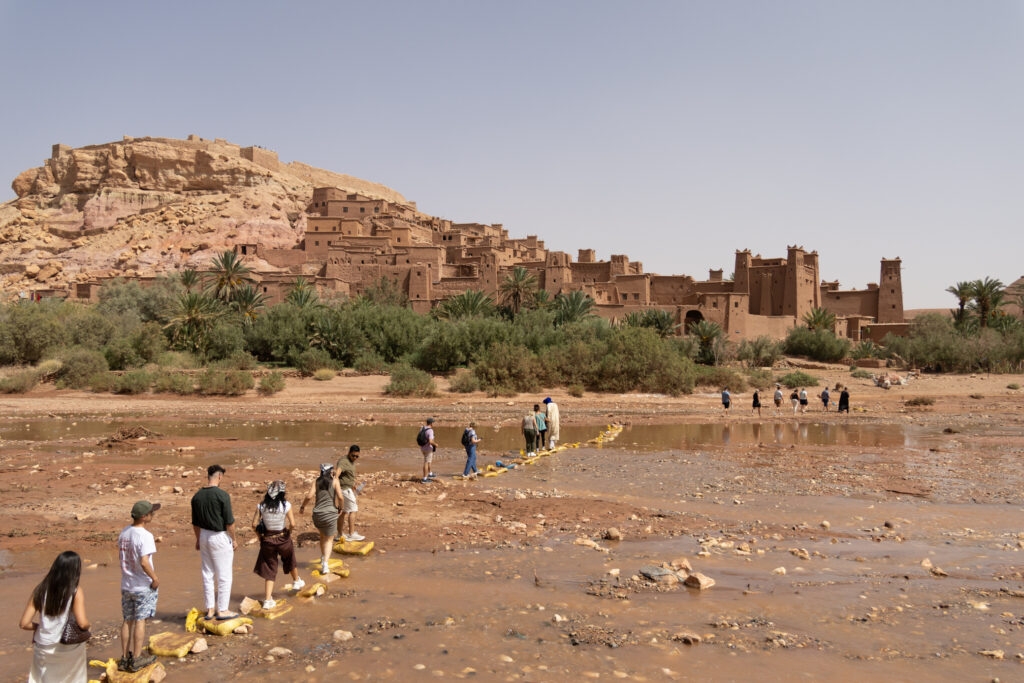
I learned a lot on this trip. It was an experience that was both amazing and bizarre. The trip started on Sunday with a long drive from Marrakech to the Atlas Mountains – with a sightseeing stop at Ait Ben Haddou, a beautiful town build out of clay which was used as a filming location for many movies and TV shows. In true Moroccan style, the only way to access it is to walk across a makeshift bridge made of sandsacks.
After our visit to Ait Ben Haddou, we continued the long drive into the mountains – which the further we drove, the more they reminded me of Utah. Fascinating bare rocks in so many colors – red, blue, green, gray… Towards the evening we finally arrived at our first guesthouse, Gite d’Etape Tamaloute in Boutaghrar. I shared a room with a fellow group member which was really basic.
The next morning, we started the core of this journey: a 4-hike through the region. This hike was led by Morocco’s first female tour guide, a member of the Gite in Boutaghrar (her brother runs it), and a fierce women in her 50s. Everyone calls her affectionately “Mama Bia”. She was married at 16ish, had a son at 17, and then divorced her husband short after. Life for someone like her back then (~37 years ago) was tough, and she lived a semi-nomadic life in the mountains with her child back then. She only spoke the local Berber language Tamazight, so communication mostly went through our 3 tour leaders. Also accompanying us was our cooking team, 4 people who also only spoke Tamazight, and who rode ahead of us on 4 mules. They really grew on us during the hike, and they always did an amazing job preparing our lunch for us.
The first day of the hike was fascinating. We hiked through the fertile river valley, where the people literally live off the land. The contrast between this green valley full of small fields of corn and fruit trees and the hot and dry clay houses just above them was incredible. I saw many people working in the fields, harvesting whatever needed harvesting, riding fully loaded donkeys or mules, or carrying big sacks of harvest on their backs. Up in the villages, they laid out sticks, poles and food for animals to dry. In the river, they were washing their laundry. Mama Bia was always checking the trees for figs or nuts to snack on. Walking through this valley felt like being in a survival game.
After roughly 5 hours of hiking, we arrived at the next guesthouse – a very basic one, where we had rooms of 5 and 6 beds that were just mattresses (sleeping bags were a requirement for this trip). In the afternoon, we learned how Couscous is made in the traditional way, and we all helped with cooking. Later, there was a lot of dancing and singing, that everyone from the team joined. It was a really fun evening.
The next day we had a different type of hike, this time mainly through the gorge, and it was gorgeous! We walked a lot through the water, it was really beautiful with the cliffsides right next to us. After we arrived and some time to rest, we learned about weaving carpets. This is a very big part of Amazigh culture, and something all women learn how to do (that’s how I understood it).
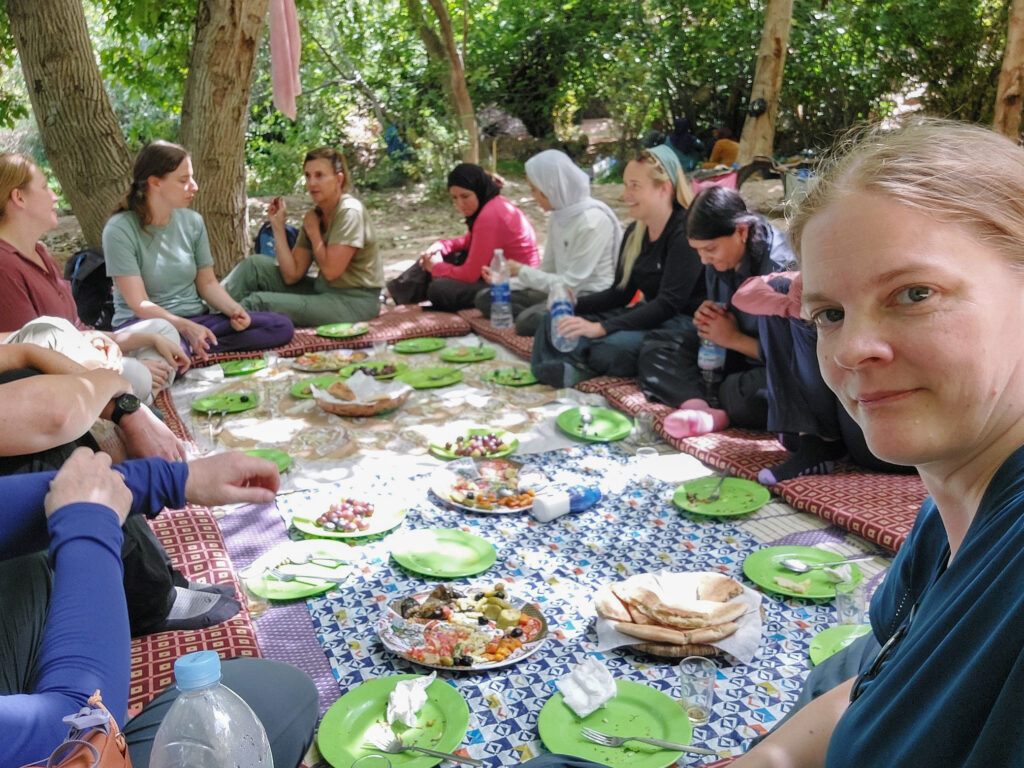
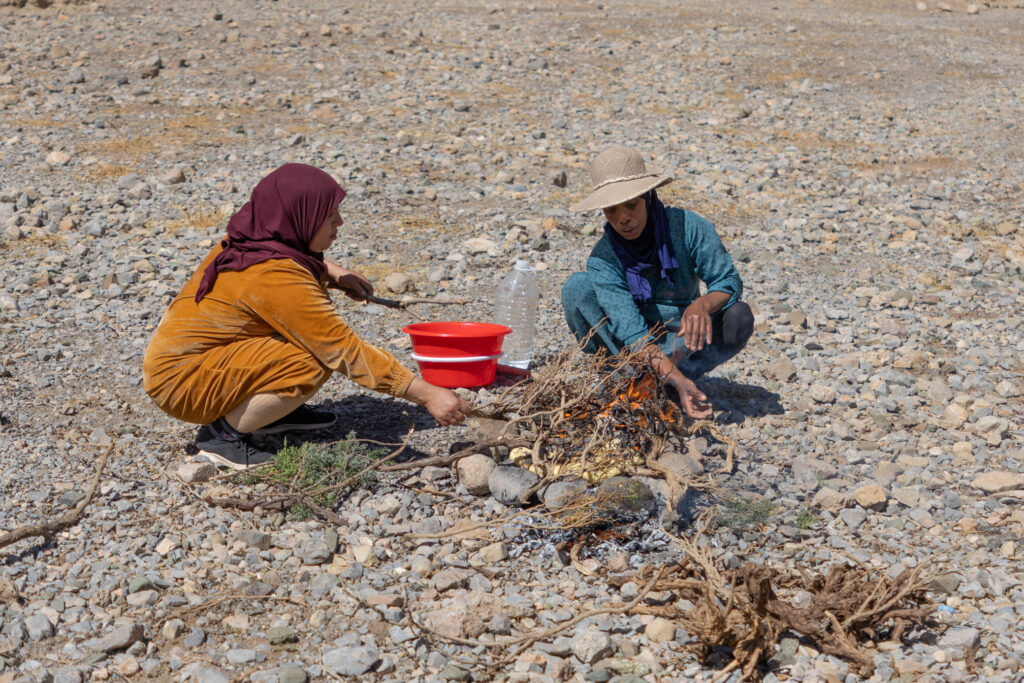
The third day was the longest hiking day of all. We started early, leaving the guesthouse already at 8, and were able to catch a bit of the sunrise over the mountain, it was very beautiful. Most of the hike was straight across the hills, up until we reached our lunch spot, where our cooking team was already busy cooking for us. Here, two of them (Zahra and Malika) also demonstrated how to make nomad bread, which is literally baked over fire. It was surprisingly delicious. And I was amazed how these women can do all their cooking squatting. I can barely do the squats in my weekly workout routine.
After lunch, we had the toughest part of the hike still ahead of us, a hike up the mountain. Mama Bia was unimpressed, she walked up that rocky hill at an incredible pace, while me (and several others) were definitely struggling a lot with the steep incline. After about an hour, we reached the peak, and it was absolutely worth the view:
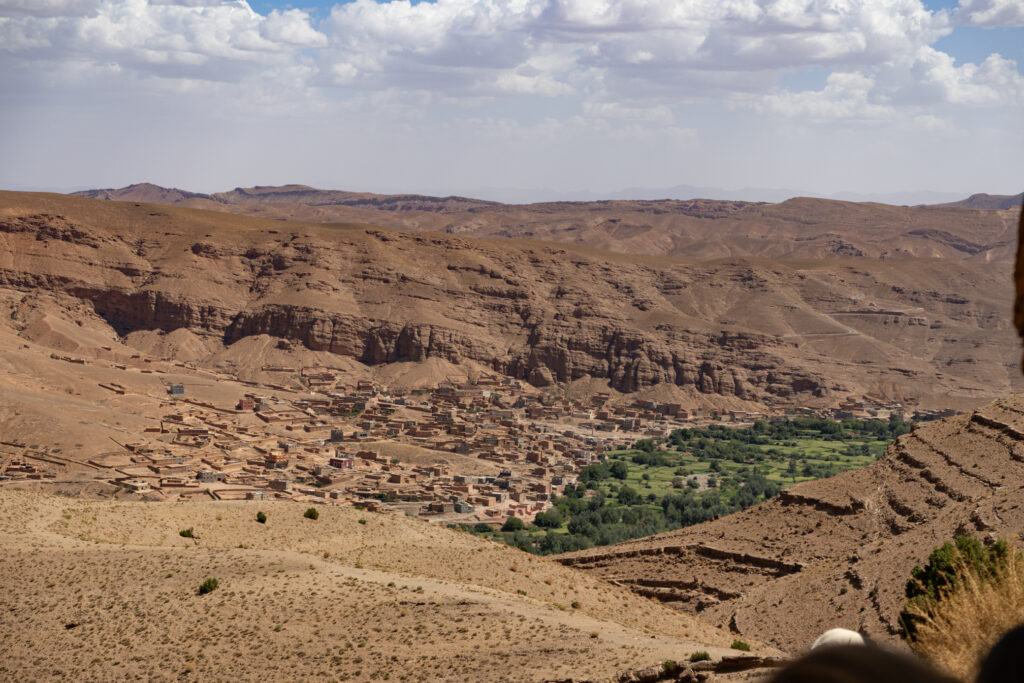
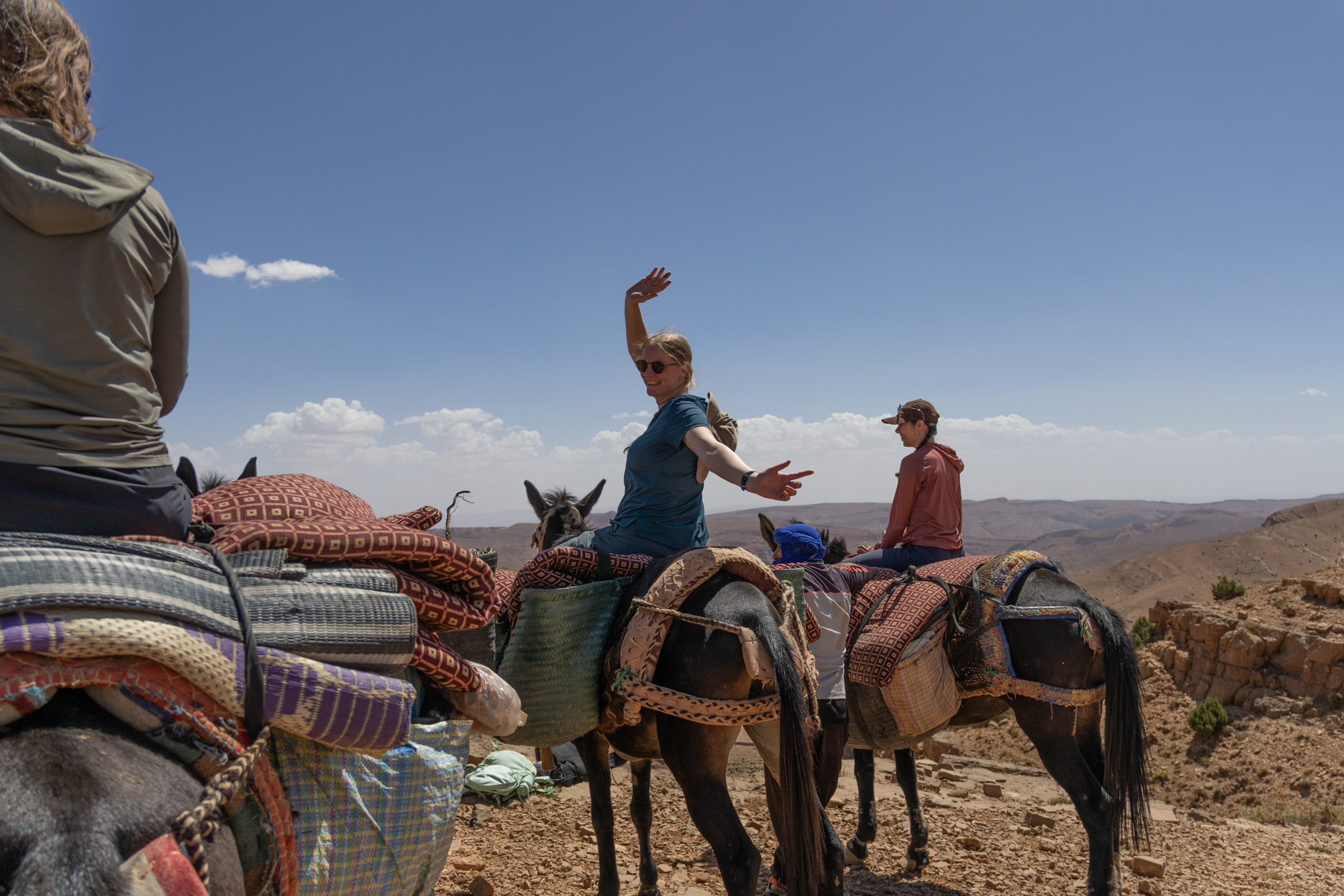
This fertile valley surrounded by clay villages really looks like something from a fairy tale. It’s amazing. Up at that viewpoint, our cooking team was already waiting for us, taking a break. Here, they also let us sit on the mules briefly. Those mules carried not only our cooking team, but also all of our luggage, our food, and the utensils for cooking (gas cookers). I expected it to be uncomfortable on top of all that stuff, but it was actually super comfy.
Mules (and other animals) play a very different role for people in this area compared to the Western world. I was very sad to learn that they don’t even have names. For me, that’s so unimaginable. How can a companion like this not have a name? But for these people, they are merely a mode of transportation, and altogether, they’re not treated the best. They were tied down by their legs when they were not being ‘used’, with very little range. The bits used on them were also pretty horrible in my opinion. I think it’s similar for all mules and donkeys I saw everywhere around these mountains. I wish there was something I could do about that, but I don’t think it’s in my power to change the mentality of an entire population, especially considering they speak neither English, nor French, and mostly not even Arabic.
Language was another absolutely fascinating aspect of this trip. I knew that French is big in Morocco, but I was amazed that literally everything is in French in Morocco. It helped me not to feel so lost, since my little bit of mediocre school French was enough to get the gist of what’s going on around me. And while most of the older generation in the Atlas mountains only spoke the Amazigh language, all of the curious school children that came to check us out spoke to us in French.
On the last day of the trek, we had a bit of everything – walking in the fields, walking on the rocky paths of the mountains, and walking in the river currents. By the end of the day, we arrived back in the guesthouse where we started, and spent the evening with a “wedding simulation” for which we all got to dress up. It was really fun, and we danced for over an hour!
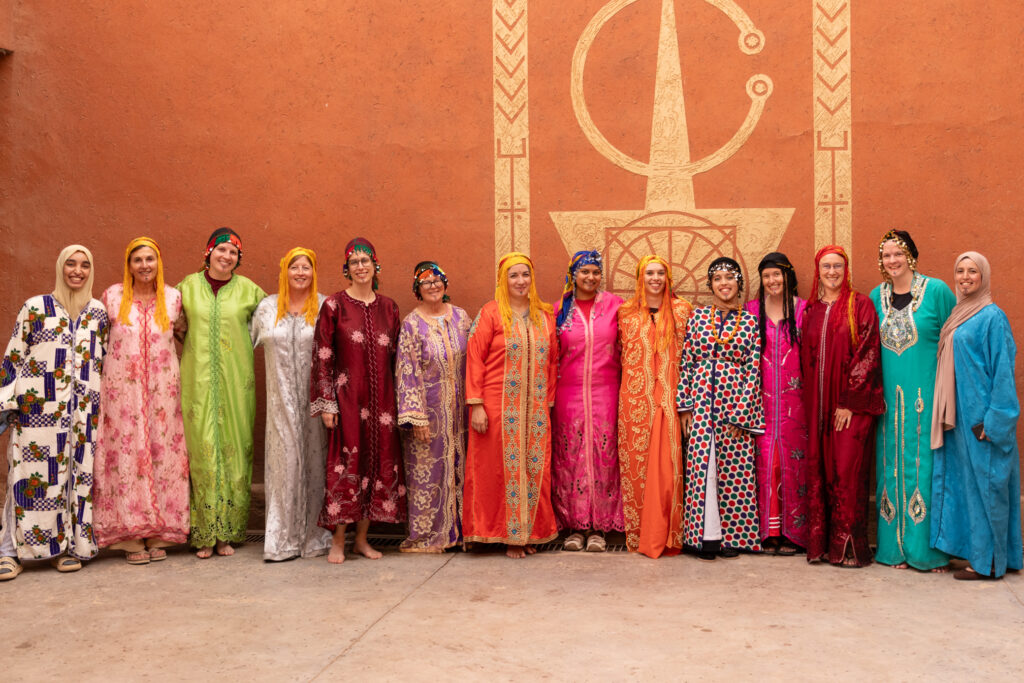
The following day was mainly driving back to Marrakech, with a few stops for shopping for rose water, carpets, and argan oil. In the late afternoon, we arrived in Marrakech, had some time to rest in the hotel, and then went out to the city for dinner in someone’s house. There were also musicians there, and it was WAY too loud… a bit of a letdown for the last night. I also regret that I didn’t actually get to see anything of Marrakech at all.
Altogether, it was a very fascinating, educational trip though. It was like stepping into a different reality. In my Western European city, I’m as far as it gets from the lifestyle and living conditions of what I’ve witnessed in Morocco. One one hand I found it fascinating that people there live like that, so in tune with nature, one the other it’s sad because I have to assume they have no other choice.
It was also very interesting that this trip focused on women in Morocco. Women there definitely still don’t have it anywhere as easy as we do, even though I think they are on the best way to make progress. Our female tour guides were great and proof that things are improving, but still only about 3% of tour guides in Morocco are women. I met a lot of very awesome women with great character and humor in Morocco, and it’s obvious how much women here support each other. But I also saw a 19-year old who was 7 months pregnant, who honestly looked pretty miserable, and who I’m pretty sure was in an arranged marriage.
I’d love to one day go back and explore all the places I didn’t get to see in Morocco. But I’d also love to go on more trips like this all around the world, and push the boundaries of my travelling comfort zone even further, because those are the experiences that are really worth it.
Write a response