
The Drowning Empire
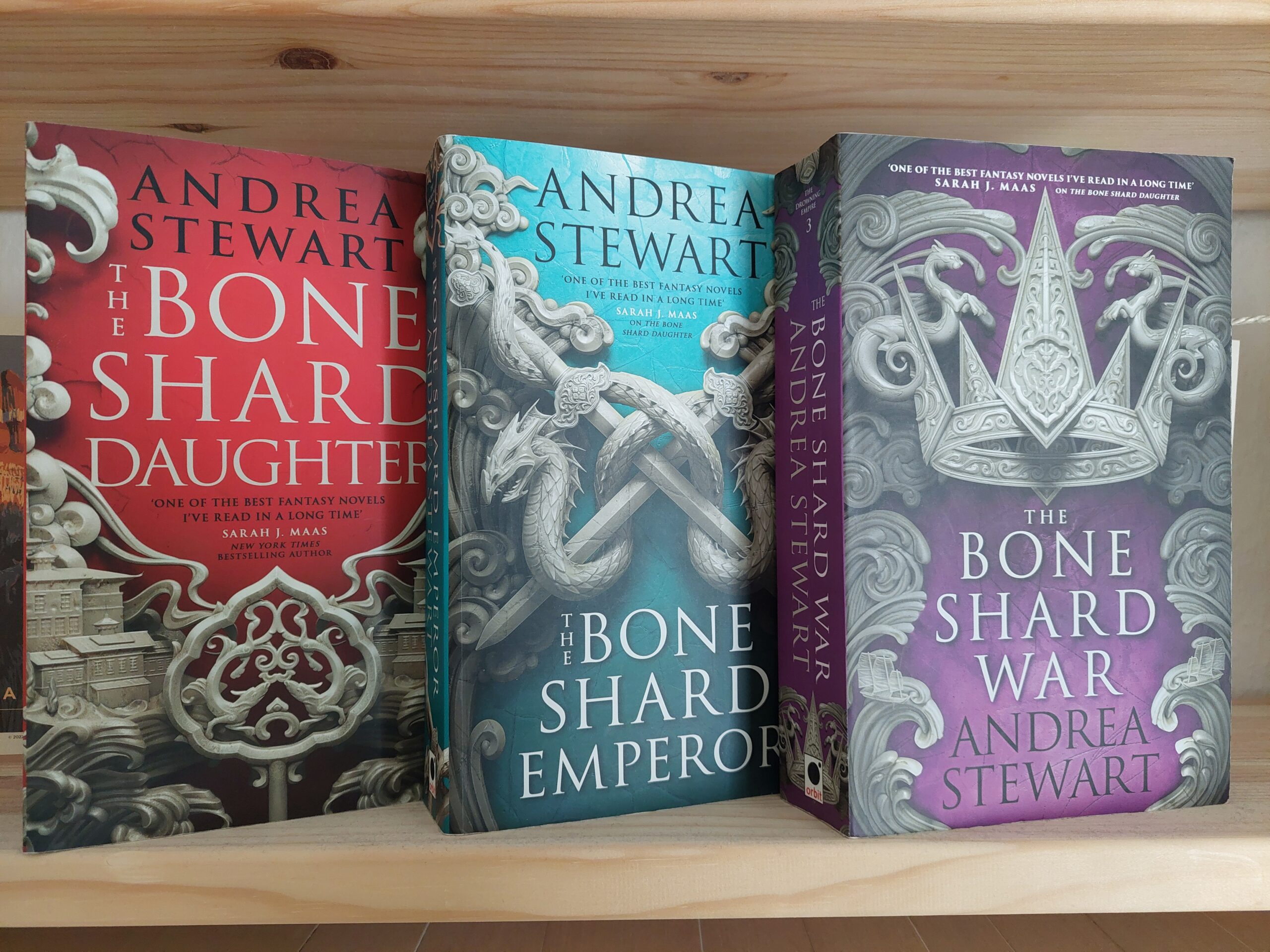
The Drowning Empire series by Andrea Stewart is a trilogy of novels consisting of The Bone Shard Daughter, The Bone Shard Emperor and The Bone Shard War. I was interested in reading this series because it comes highly recommended especially by fans of the Realm of the Elderlings series (probably my favorite book series), and because it was supposed to have a few themes and topics that I’m generally interested in – here, in particular, it was animal characters.
I actually pitched The Bone Shard Daughter for the recently founded book club that I’ve been attending, since it was supposed to work also as a standalone – now that I’ve read it, I don’t really think so. Regardless, I’ve read it for the book club, and afterwards also read the two follow-up books.
I actually liked The Bone Shard Daughter a lot more than I expected. The series has such a unique concept of magic, that actually has some sci-fi vibes even though it’s entirely fantasy – it’s called bone shard magic, and it works a bit like computer programming – by inscribing commands on bones that are inserted into constructs. As someone who is experienced in programming, it was kinda funny to me to see how this translates to fantasy magic (and I found it incredibly ironic that this empire is basically run by AI).
This series has multiple POVs, which is usually not something I’m very keen on. I much prefer a single POV, because I tend to get bored with the less interesting characters in multiple POV stories. This series does it better than most, in particular with the two main characters Lin and Jovis. I enjoyed reading them both equally – Jovis maybe even more than Lin, which is ironic because it seemed to me that Lin is supposed to be the main character. Both of these are told in first person perspective, which is also rather unconventional for multiple POV books, while there are a few other POVs told in third person – Sand, Ranami and Phalue – all of which I found the least interesting.
I also really enjoyed the animal bonding in this book, one of the main reasons why I was interested in reading this. Since the Realm of the Elderlings, I’ve never encountered a work of fiction that did animals so well and realistically and made them characters with personalities. The Bone Shard Daughter definitely tried that with the characters of Jovis (human) and Mephi (???), but I found it a bit harder to relate to here, because it’s hard to imagine what kind of creature Mephi really is. A dog? A weasel? A horse? A dragon? A sea serpent? It’s always very vague and does not get easier to imagine as the series progresses. It was still fun to see this bond form, and was somewhat bittersweet for me because I recently lost a bond like that in my life.
Some characters generally felt a bit underdeveloped and perhaps too stereotypical to me, such as Ranami and Phalue. They seem to be the token lesbians, and while I found it quite interesting to read a novel set in a queer-normative world, where LGBTQIA+ is just as accepted as adoption, their characters didn’t really fulfill their whole potential. Especially Phalue seemed too much of a trope tomboy to me.
Altogether, I thought The Bone Shard Daughter was very well written and well paced. The language in the novel makes it a easy and quick read, as the author uses a lot of very short sentences. I’m not complaining about that, because that’s exactly what I usually look for in fiction – easy to read, entertaining and fun. This style of writing continues through the next two novels.
The second novel, The Bone Shard Emperor takes the story in a different direction. Where the first was fully focused on bone shard magic and the mystery of Mephi, the second book shows us Lin struggling to adjust in her new role as emperor. IMHO it’s pretty rare that the second book in a series can live up to the first. Most of them suffer from “second book syndrome”, but I’m happy to say that that is not the case with this book. The plot builds strongly on the revelations of the first book, but goes into new and different directions, brings new mysteries, and ends with new and somewhat surprising plot twists. I enjoyed reading it just as much as the first book.
Now the only question that remains is whether The Bone Shard War will neatly tie up all the remaining mysteries… well, I was not a fan of how the third book started, and I have to admit I’m rather disappointed in the third book as a whole. It starts with a 2 year time jump, and with very drastic changes to Jovis’ situation that I was really not a fan of.
With over 600 pages (as opposed to 400/500 in the previous books), I feel this book was way too long for what it was trying to do, and as a result the pacing felt really off. The more I read, the more confused I got, and I felt it became more difficult to keep track of the characters. There was a lot of travelling around, sometimes characters clashed, then parted again. Altogether, I couldn’t really understand Nisong’s or Ragan’s motivations. A lot of characters seemed to flip without a clearly discernible reason, namely Nisong and Dione. The multiple POVs did not help here either.
I wasn’t a huge fan of the romance aspect of this series at all, which mainly became a factor in the final book. It didn’t really feel natural to me, and I think the affected characters would have been better in a platonic relationship. Maybe this was forced upon the writer by the publisher, because romantasy is all the rage now? (I wouldn’t call this book romantasy at all though).
Altogether, I’m happy we got answers to pretty much all the mysteries in the final book, but I feel this could have been SO much better and more satisfying as a conclusion to the series if it would have been shorter, better paced, and with better character motivations and developments. I enjoyed reading the series as a whole, and would recommend it to anyone looking for an easy, low-effort read. It’s a great series to get back into a habit of reading if you’ve been in a reading slump as well.
Write a response