
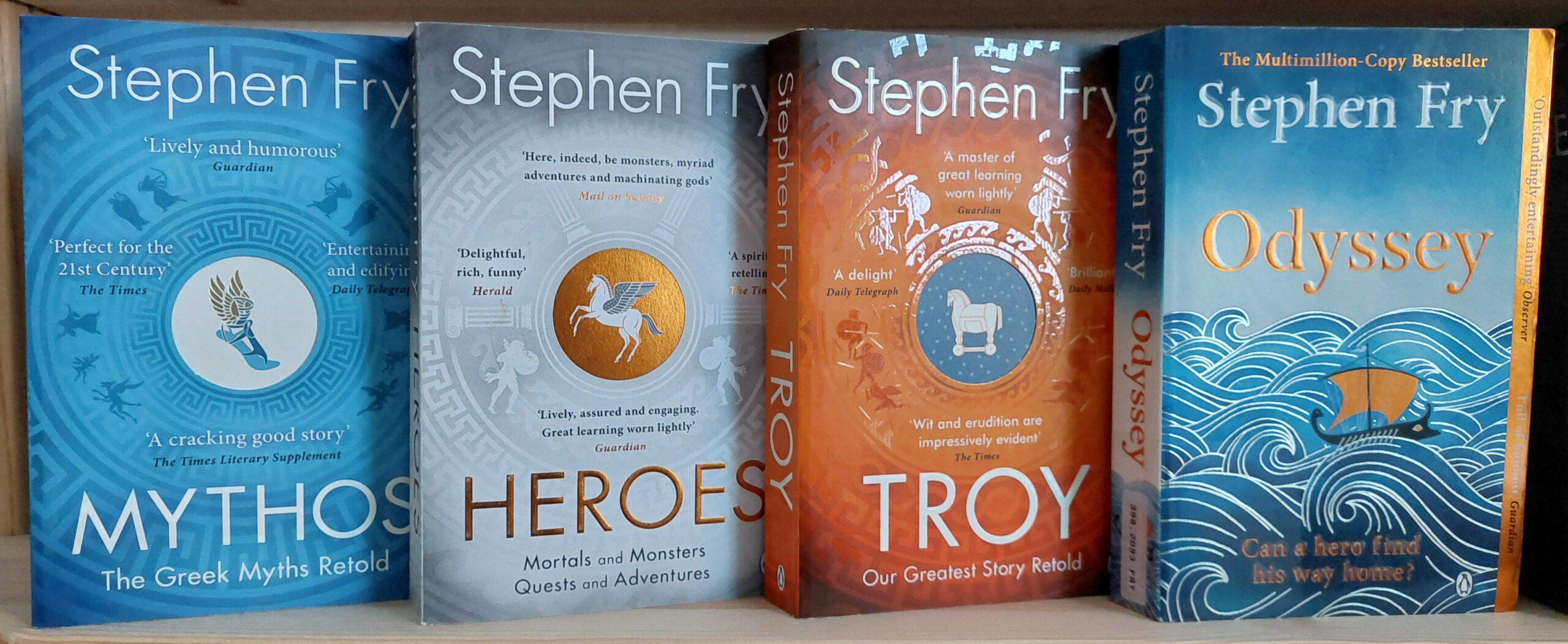
Stephen Fry’s Greek Mythology Books
Greek Mythology and I have a complicated relationship. I definitely learned about Greek myths in school at some point, and to this day I still have a fairly basic book on Greek Mythology on my bookshelf. Then came my “wild phase”, and I thought that Norse Mythology was sooo much cooler and more metal than Greek Mythology! In part, my former favorite novel American Gods was also responsible for that.
Then a couple of years ago I started playing in a Greek-inspired DnD campaign. That’s when my interest for Greek Mythology really surfaced, because even though I was vaguely familiar with all those myths, my knowledge was fairly superficial.
Fast forward a few years, and as I was getting back into reading, I somehow stumbled upon Stephen Fry’s book series on Greek Mythology! Say no more! I’ve always held Stephen Fry in high regard, he’s a very diligent and smart person with a lot of talents. I watched a lot of his documentaries, and for a while I was a fan of QI. I even went to a live screening of QI once, and got to see the man in real life from the audience!
So I got myself a copy of the first book, Mythos, and started reading that. And while I loved this book – it’s a very lively and imaginative retelling of the Greek myths – I was struggling a bit to get through it because it’s sooo incredibly dense and is more like a short story collection, and I’m just not a fan of short story collections.
Having said that, it’s still a really great book that gives a great overview of the most well known myths, and it’s super interesting to learn more about them, because my knowledge of Greek mythology was rather superficial so far. I also found it particularly fascinating to realize how much of our modern society and our language has its origin in Greek mythology. Stephen Fry is also a hobby linguist, and it shows that he enjoyed adding a lot of etymological insights here and there.
Moving on to the second book, Heroes, I have to admit that I enjoyed this sequel to Mythos much more than its predecessor, probably because it tells a much more coherent narrative (or tries to, at least). Mythos was sometimes random and allover the place and hard to follow. This book, however, focuses on a number of Greek heroes and tells their stories in a more or less coherent manner (but still, even these myths are very convoluted and intertwined).
I felt this trend reverted a bit in the third book, Troy. My main problem was that there are SO many names, and it’s not very clear which of them are truly important going forward, and which are just someone’s grandparent that will never be mentioned again. What I expected to be one of the more straightforward stories, was in fact another extremely convoluted mess of the machinations of all the gods and goddesses, but I suppose that’s just the nature of Greek mythology.
The fourth and final book, The Odyssey, concludes the cycle of these myths. Mythos taught us everything about the titans and the gods, Heroes about their demi-god offspring, and starting with Troy, we were mostly looking at normal humans, albeit with some degree of divine ancestry – most notably Odysseus himself as the great-grandchild of the god Hermes.
In this epic finale of Stephen Fry’s Greek Mythology series, the book tells the story of Odysseus’s long journey home from the Trojan war, in which he was a soldier. It starts a bit convoluted and Odysseus isn’t even the main character until about 1/4th into the book, plus the switch to Roman names when telling the story of Aeneas was very confusing.
But once we actually reach Odysseus, it becomes super fun and compelling to read. And here I was surprised how well I actually remembered this myth, Odysseus’ journey, and the details of his homecoming. An excellent, witty and very entertaining re-telling of the Odyssey.
Altogether, reading all of these books has taught me a lot, and it was an enlightening experience. These myths really are the basis for so many things in our world from storytelling to culture to linguistics. So many modern stories are variations of the epic quests or conflicts or journeys home that we can find in Greek mythology. So many basics of our culture and democracy are mirrored in Greek mythology. And so many words have their root in some Greek myth. A great reading experience, that was both entertaining and educational.
Write a response